Nirmana Gloria
NirmanaMemuat gambar...
Klik gambar untuk zoom
"
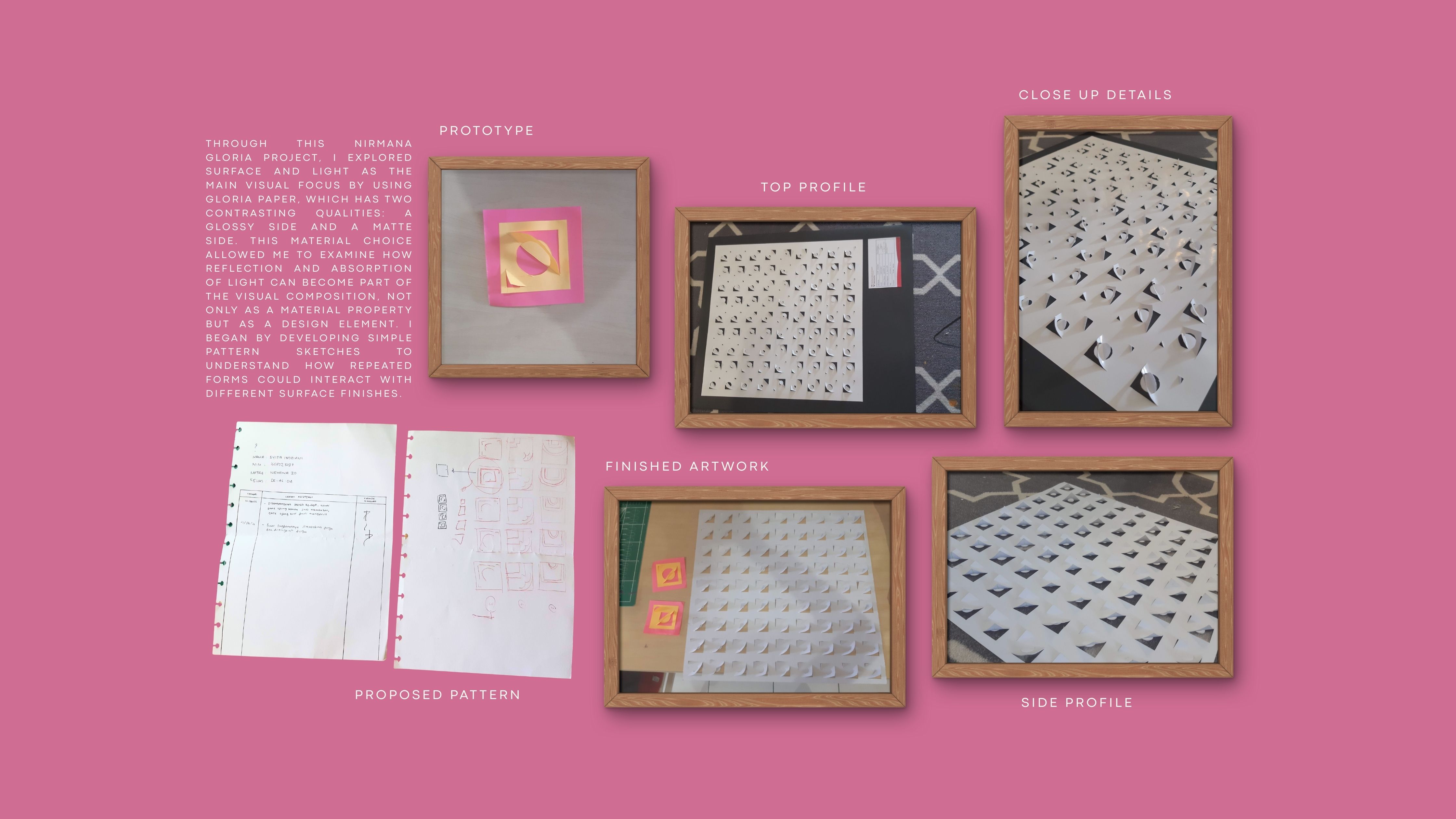
Through this Nirmana Gloria project, I explored surface and light as the main visual focus by using Gloria paper, which has two contrasting qualities: a glossy side and a matte side. This material choice allowed me to examine how reflection and absorption of light can become part of the visual composition, not only as a material property but as a design element. I began by developing simple pattern sketches to understand how repeated forms could interact with different surface finishes. In the prototyping stage, I experimented with cutting and folding the Gloria paper to create modular units. By arranging these units in a structured grid, I observed how the glossy surfaces reflect light differently depending on their orientation, while the matte surfaces create softer and more stable visual areas. This contrast helped define depth and movement without relying on color variation. During the making process, precision and consistency were crucial, as the glossy surface easily highlighted imperfections. Each cut and fold had to be carefully controlled to maintain uniformity across the composition. Through repetition, the pattern gradually formed a rhythmic surface that changes visually based on viewing angle and light conditions. The finished artwork presents nirmana as an exploration of light, texture, and spatial perception. By combining the glossy and matte sides of Gloria paper, I learned how material characteristics can actively shape visual experience. This project strengthened my awareness of how surface treatment and material choice contribute to emphasis, rhythm, and unity within a composition.
Syifa Indriani•4 Februari 2026