Nirmana Garis
NirmanaMemuat gambar...
Klik gambar untuk zoom
"
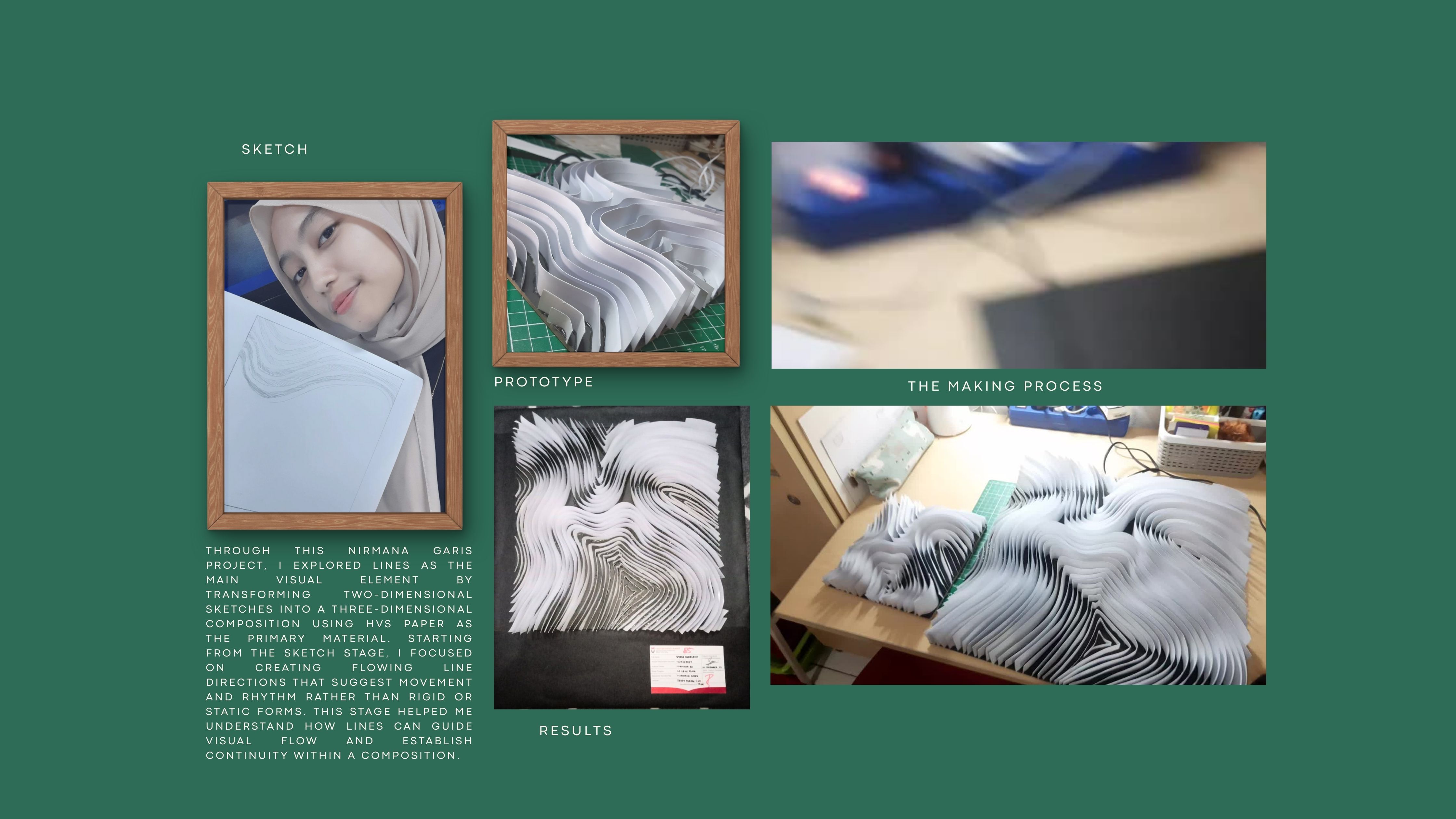
Through this line nirmana project, I explored lines as the main visual element by translating two-dimensional sketches into a three-dimensional form. Starting from the sketch stage, I focused on developing flowing line directions that suggest movement and rhythm rather than rigid structure. This initial exploration helped me understand how lines can guide visual flow and create a sense of continuity within a composition. In the prototyping stage, I transformed the sketched lines into layered forms by cutting and arranging materials in a repetitive sequence. This process allowed the lines to evolve into physical contours, emphasizing depth and spatial interaction. By stacking and aligning each layer carefully, I aimed to maintain the original line direction while introducing volume and texture. During the making process, precision and consistency became essential, as each line-shaped layer had to be positioned accurately to preserve the overall visual rhythm. Small changes in alignment could significantly affect the perception of movement, making this stage both technically demanding and conceptually important. The final result presents line nirmana as a dynamic composition where lines no longer function solely as outlines, but as structural elements that define form, depth, and motion. Through this work, I developed a stronger understanding of how lines can construct space and convey energy, while also strengthening my discipline in planning, prototyping, and execution.
Syifa Indriani•4 Februari 2026
Credits / Team
S
Syifa Indriani
Artist